
Divyasaṅgamaḥ Anantam
Divyasaṅgamaḥ Anantam - Organization Charter
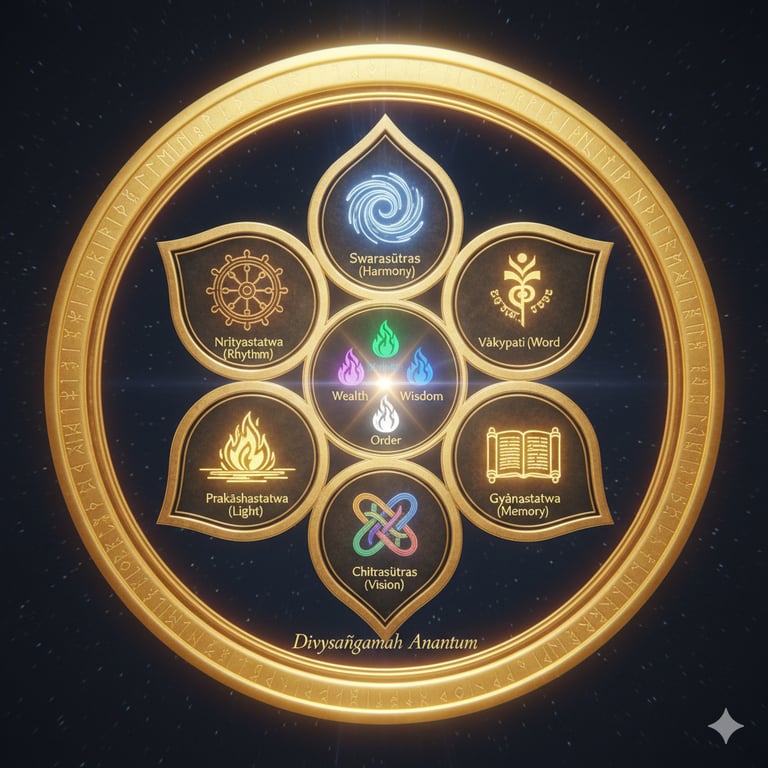
The Divyasaṅgamaḥ Anantam — The Infinite Confluence of the Divine — is not an empire of crowns but a covenant of guardianship, founded when the Six Guardian Species united: Swarasūtras (Harmony), Nṛityastatwa (Rhythm), Vākyapati (Word), Prakāshastatwa (Light), Gyānastatwa (Memory), and Chitrasūtras (Vision). With them stand the Four Eternal Guardians — embodiments of Wealth, Wisdom, Order, and Spirit. Together they form the Council of Ten, the highest seat of stewardship, entrusted with law, service, and balance.
In times of peril, protection falls to the Six Defence Commanders, one from each Species, who lead armies sanctified not for conquest but for guardianship. Bound by oath, they raise arms only to defend, never to enslave, and are charged with restoring realms after war. Council and Command together form the Sixteen Pillars of the Confluence — a fellowship where vision, principle, and action are woven into one.
The Union’s wealth flows through its Ten Service Dominions: knowledge, manpower, art, diplomacy, finance, peace, nature, arbitration, memory, and paths. Sustained by the Charity Flow — the tithe of ten percent — and guided by the Dominion of Commerce, these dominions ensure that resources circulate as rivers of service, never as hoards of greed.
Its Code of Conduct binds every member to renounce conquest, preserve dignity, act in transparency, protect the weak, and raise arms only in defense. Its jurisdiction extends wherever balance falters, always by invitation, never by dominion. Its alliances are rivers of trust, its amendments restrained by eternal vows, and its armies sanctified by ritual and banner.
Thus the Union proclaims: its breath is harmony, its heartbeat service, its soul the dignity of all life. By vow eternal, by truth unbroken, by confluence unending — the Divyasaṅgamaḥ Anantam shall endure for all ages.
Divyasaṅgamaḥ Anantam—Organization Charter
1. Founding Vision & Preamble
Before dominions divided themselves with crowns and thrones, before conquest carved scars across the realms, there was a truth greater than power — that harmony is the first law of creation. Rivers flow into rivers, melodies blend into chorus, light and shadow meet to reveal form: all of existence is born of confluence. From this eternal truth arose the vow that became Divyasaṅgamaḥ Anantam — The Infinite Confluence of the Divine. It was founded when Six Guardian Species rose together, not as rulers but as stewards:
Swarasūtras, Guardians of Harmony — who taught that all conflict may be tempered through the weaving of sound.
Nṛityastatwa, Guardians of Rhythm — who showed that movement and cycle can dissolve disorder and restore balance.
Vākyapati, Guardians of Word — who bound reality with speech, silencing corruption and affirming truth.
Prakāshastatwa, Guardians of Light — who revealed that illumination does not conquer but liberates, dissolving shadow.
Gyānastatwa, Guardians of Memory — who held the record of wisdom, ensuring no truth was lost to the ages.
Chitrasūtras, Guardians of Vision — who shaped imagination into form, inspiring futures yet to be born.
Together they proclaimed: There shall be no empire in our name, but a covenant. No dominion in our hand, but stewardship. No conquest in our banner, but service.
Thus we vow:
That knowledge shall be nurtured, so no age falls into ignorance.
That leaders shall be raised, not for vanity, but for guardianship.
That art shall be preserved, for harmony itself heals what conquest wounds.
That diplomacy shall be exalted, so war remains the last resort, not the first.
That wealth shall be stewarded, to bring fairness, not greed.
That peace shall be gifted, wherever calamity rends lives.
That nature shall be protected, its treasures kept from exploitation.
That conflicts shall be arbitrated, in halls of balance, not on fields of ruin.
That memory shall be preserved, for without record, futures cannot stand.
That paths shall be safeguarded, so flows of trade, culture, and life remain unbroken.
This is the covenant of Divyasaṅgamaḥ Anantam: not an empire of rule, but a fellowship of service; not a throne of dominance, but a circle of guardianship. Its breath is concord, its rhythm is balance, its soul is the dignity of every realm. By oath unending, by harmony eternal, by truth indivisible — The Infinite Confluence shall endure for all ages to come.
2. The Sacred Symbol & Identity of Divyasaṅgamaḥ Anantam
The Sacred Symbol: At the heart of the Infinite Confluence stands the Mandala of Saṅgama, the eternal seal of harmony. It is not ornament, but instruction — a living reminder of unity, service, and balance.
The Six Petals of Confluence: Arranged in a radiant lotus around the center, six emblems mark the Guardian Species:
Swarasūtras (Harmony) → a flowing spiral of sound, weaving concord.
Nṛityastatwa (Rhythm) → a turning wheel, symbol of cycle and movement.
Vākyapati (Word) → a glyph of speech, echoing the power of utterance.
Prakāshastatwa (Light) → a radiant flame, dissolving shadow and revealing truth.
Gyānastatwa (Memory) → an open scroll, keeper of wisdom across ages.
Chitrasūtras (Vision) → a woven thread, symbol of imagination shaping form.
The Four Eternal Pillars: At the mandala’s core glow four steady flames, not above the Six but within their circle — for principles exist only when embodied by creation:
Wealth → provision without greed, abundance without hoarding.
Wisdom → counsel without bondage, discernment without pride.
Order → justice without cruelty, balance without tyranny.
Spirit → dignity without shadow, essence without decay.
The Circle of Infinity: Encircling all is a line without break, the Circle Unending — reminder that harmony is timeless, that unity once broken must be restored, that confluence flows without beginning or end.
Thus the symbol declares: The Six are nothing without the Four, the Four are nothing without the Six, and all are bound within eternity.
The Identity: The identity of Divyasaṅgamaḥ Anantam is not in crowns or dominions, but in vow and service. Its guardians are not rulers but custodians; not conquerors but servants of harmony.
We do not rule; we unite.
We do not conquer; we reconcile.
We do not hoard; we distribute.
We do not enslave; we restore.
Every member who bears the Mandala of Saṅgama is recognized not by lineage nor by might, but by vow. To carry this mark is to be named Keeper of Concord, custodian of peace, steward of balance, and servant of the dignity of all realms. The Union’s identity rests on this truth: its breath is service, its heartbeat harmony, its soul the unbroken dignity of creation.
3. Purpose, Objectives & Core Values
The Purpose: The Divyasaṅgamaḥ Anantam exists as a covenant of service, not as an empire of rule. Its purpose is to ensure that harmony among realms is preserved, that wisdom is never lost, that justice is never abandoned, and that peace is restored wherever calamity or discord arises. It is founded to be the meeting-place of strengths, where sound, rhythm, word, light, memory, and vision converge with wealth, wisdom, order, and spirit. Its existence proclaims: confluence is stronger than conquest, and service is greater than sovereignty.
The Objectives: The Union sanctifies its mission through clear objectives, which form the compass of all its actions:
To nurture knowledge → Establishing schools, academies, and sanctuaries of learning so every realm has visionaries, guides, and protectors of wisdom.
To raise leaders → Training and providing skilled guardians, mediators, and commanders where clans, houses, or planets require strength.
To preserve art and harmony → Ensuring that music, dance, and cultural expression flourish as medicines against despair and division.
To exalt diplomacy → Offering emissaries and arbiters so that negotiation may prevail before violence.
To safeguard wealth → Auditing and distributing resources with fairness and transparency, ensuring no hoarding breeds inequality.
To bring peace and relief → Delivering aid, medicine, and reconstruction wherever calamity strikes.
To protect nature → Guarding forests, oceans, medicines, gems, and elemental forces from exploitation.
To arbitrate conflict → Resolving disputes in the halls of balance before they spill into fields of war.
To preserve memory → Keeping archives of law, wisdom, trade, and survival for all generations.
To guard the paths → Maintaining infrastructure and safe passage for goods, knowledge, and beings across the realms.
The Core Values: At its heart, Divyasaṅgamaḥ Anantam is bound by values that no era may corrupt:
Harmony → All voices woven together, none silenced, none exalted beyond balance.
Service → Every dominion exists not for profit, but to provision life and dignity.
Justice → Law is tempered by compassion; authority exists only to preserve fairness.
Wisdom → Truth is spoken plainly, illusions dispelled, and discernment shared without pride.
Peace → Arms are raised only in defense, and always lowered in restoration.
Preservation → Nature, memory, and culture are protected as sacred legacies for future ages.
Unity without Dominion → Confluence is strength, empire is weakness; union without conquest is eternal.
4. Scope of Authority & Jurisdiction
The Divyasaṅgamaḥ Anantam is not an empire and does not lay claim to thrones, crowns, or dominions. Its authority is not over lands but over vows; not over realms but over the covenant of service. Its jurisdiction extends only where balance is threatened, where peace requires guardianship, and where service is sought.
The Circle of Authority
The Council of Ten (Stewardship & Management)
Composed of the Six Guardian Species Leaders and the Four Eternal Guardians.
Entrusted with governance, administration of Service Dominions, preservation of law, and guardianship of harmony.
Their authority is sacred stewardship — to guide, not to rule; to manage, not to dominate.
The Six Defence Commanders (Martial Arm)
One chosen from each Guardian Species.
Hold authority in matters of battle and defense, fully empowered in the field when conflict arises.
Bound by the sacred restraints of the Covenant: no conquest, no spoils, and duty of restoration.
The Mandate of Jurisdiction
Within Realms of Service: The Union acts where famine, disaster, injustice, or imbalance demand aid. It may establish Service Dominions — of knowledge, peace, finance, nature, memory, or paths — wherever invited or where silence would mean betrayal of the vow.
Between Realms in Conflict: The Union intervenes as mediator before it intervenes as defender. Its halls of arbitration serve as neutral ground; only when mediation fails and oppression persists may its Defence Commanders rise.
Across the Flows of Trade and Knowledge: The Union safeguards the highways of civilization. It oversees archives, routes, ports, and cultural exchanges to ensure that knowledge, sustenance, and truth flow unbroken.
Sacred Restraints on Authority
The Union may not seize dominion over any land, house, or crown.
It may not levy conquest nor absorb realms into empire.
It acts only upon invitation, need, or guardianship’s vow, never as conqueror.
It withdraws when peace is restored, leaving stewardship to the rightful custodians of their own realms.
Thus the authority of Divyasaṅgamaḥ Anantam is not measured in territory, but in trust; its jurisdiction not in dominion, but in service. Wherever its symbol is borne, it speaks not of conquest but of covenant, not of rule but of unbroken harmony.
5. Membership & Eligibility
The Divyasaṅgamaḥ Anantam is not bound by race, realm, lineage, or throne. Its fellowship is open to all who uphold its vow. Membership is determined not by birthright, but by service; not by inheritance, but by commitment to harmony and guardianship.
Eligibility: Any being, clan, house, or realm may seek entry, provided they:
Renounce conquest, tyranny, and exploitation.
Swear service to harmony, peace, and balance.
Accept equality with all members, without prejudice of race or power.
Submit to the laws, vows, and codes of the Union.
Membership is thus open to mortals, celestials, species, guilds, and even realms, so long as their vow is true.
The Oath of Membership: Every initiate is consecrated through the Oath of Confluence, spoken before the Circle of the Ten:
To unite where division festers.
To provision where hunger lingers.
To mediate where discord rises.
To heal where calamity strikes.
To preserve dignity where it falters.
To remember truth where it fades.
This oath is not ceremony but covenant — once spoken, it binds the member to service eternal. To betray it is to break with the Union itself.
Paths of Membership
Council & Leadership: Seats in the Council of Ten are reserved to the Six Guardian Species and Four Eternal Guardians, who embody harmony’s highest stewardship.
Defence Commanders: One from each Species is chosen to serve as martial protector, bearing authority only in war and defense.
Service Circles & Dominions: All other members — individuals, guilds, or realms — serve within the Service Dominions. Here they labor in knowledge, peace, finance, nature, archives, diplomacy, and restoration, sanctifying work as service.
Assemblies: Every member is granted voice in assemblies, ensuring the Union is guided by all and not by few.
Loss of Membership: Membership may be stripped if:
A vow is broken through conquest, exploitation, or betrayal.
Service is abandoned for pride or profit.
Arms are raised against the covenant itself.
Such expulsion is not vengeance, but preservation of the Union’s sanctity.
Thus membership is sacred: open to all who vow harmony, equal to all in dignity, firm in law, eternal in service.
6. Organizational Structure & Divisions
The Divyasaṅgamaḥ Anantam is shaped not as an empire of thrones, but as a fellowship of service, structured into three living arms — Council, Defence, and Service. Together they form the Sixteen Pillars of the Confluence, through which vision, protection, and provision are bound in eternal harmony.
The Council of Ten — Governance & Stewardship
Composition
Six Guardian Species Leaders → Harmony, Rhythm, Word, Light, Memory, Vision.
Four Eternal Guardians → Wealth, Wisdom, Order, Spirit.
Mandate
To preserve the vows of the Confluence.
To guide all Service Dominions and Assemblies.
To resolve disputes and maintain unity among members.
To give sanction for defence, ensuring arms are raised only for peace.
The Council of Ten is the soul of governance, binding principles and species together as custodians of harmony.
The Six Defence Commanders — Martial Arm
Composition
One Commander chosen from each Guardian Species.
Mandate
To lead the armies of defence when realms are threatened.
To act decisively in war, yet bound by restraint: no conquest, no spoils, duty of restoration.
To safeguard sacred sites, noncombatants, and balance of realms.
The Defence Commanders are the shield of the Union, empowered in battle but forever accountable to the Council of Ten.
The Service Dominions — Provision & Preservation
Composition
Ten sacred dominions of service: Knowledge, Manpower, Arts, Diplomacy, Finance, Peace, Nature, Arbitration, Memory, and Paths.
Mandate
To provide sustenance, wisdom, aid, and preservation to all realms.
To prevent hoarding, exploitation, or imbalance of resources.
To ensure harmony flows through every aspect of life — from learning to culture, trade to peacekeeping.
The Service Dominions are the hands of the Union, laboring not for profit but for universal provision.
Assemblies & Circles — The Wider Fellowship
Composition
Members beyond the high seats, gathered in assemblies and service circles.
Mandate
To deliberate, advise, and hold leaders accountable.
To embody the vow of inclusivity — where every voice is heard, from mortal to celestial, from guild to realm.
Assemblies ensure the Union remains not the voice of rulers, but of the fellowship entire.
The Sixteen Pillars of the Confluence
Council of Ten → Vision and Stewardship.
Six Defence Commanders → Protection and Martial Execution.
Together they form the Sixteen Pillars, around which the Service Dominions and Assemblies gather. This structure ensures that no arm stands alone: principle is bound to species, governance is bound to service, and war is bound to peace.
7. Leadership, Governing Body & Roles
The Divyasaṅgamaḥ Anantam is guided not by monarchs but by stewards of vow. Its governing fellowship is embodied in Sixteen Seats of Harmony: ten stewards who weave the Union’s law and service, and six commanders who defend it in times of peril.
The Four Eternal Guardians — Custodians of Principles
Dhanavīra Satyadhāra, Arthādhipa — Guardian of Wealth & Provision (Male): Custodian of abundance, who ensures sustenance flows freely, never bound by greed.
Prajñāvatī Amṛtashruta, Mantrādhishī — Guardian of Wisdom & Counsel (Female): Voice of discernment, whose counsel unveils truth and guides without chain or bondage.
Rājanyavān Nyāyavāhin, Ritvāhana — Guardian of Order & Justice (Male): Bearer of balance, binding law to compassion and justice to restraint.
Ātmaprabhā Anantajyoti, Ātmadhārā — Guardian of Spirit & Essence (Female): Living flame of dignity, preserving the inner light of all beings and sanctifying life’s breath.
The Six Guardian Species — Keepers of Creation’s Subtle Forces
Svara Anantadhvani, Swarasūtras — Guardian of Harmony (Male): Celestial musician whose eternal chords weave sorrow into healing and chaos into balance.
Nṛitya Vyomavāhinī, Nṛityastatwa — Guardian of Rhythm (Female): Sacred dancer whose movements mirror creation’s cycles, dissolving disorder through divine rhythm.
Vākya Satyashruti, Vākyapati — Guardian of Word (Male): Timeless lord of utterance, whose speech shapes reality and silences corruption with truth.
Prakāsha Jyotirvāhana, Prakāshastatwa — Guardian of Light (Female): Radiant essence whose brilliance reveals hidden paths and dissolves shadows of deceit.
Jñāna Smṛtipāla, Gyānastatwa — Guardian of Memory (Male): Eternal keeper of remembrance, preserving wisdom so no truth is ever lost to time.
Chitra Kalpavistāra, Chitrasūtras — Guardian of Vision (Female): Cosmic dream-weaver, shaping imagination into form and inspiring gods, mortals, and worlds alike.
The Six Defence Commanders — Protectors in War & Calamity
Rāgānanda Surdhvani, Swarasūtras — Commander of Harmony (Male): Master of martial cadence, who turns music into shield and battlefields into symphonies of order.
Nṛityā Vīravāhinī, Nṛityastatwa — Commander of Rhythm (Female): War-dancer whose sacred steps unsettle armies and restore balance through the rhythm of battle.
Vākpatir Ajitashruti, Vākyapati — Commander of Word (Male): Warlord of sacred speech, whose commands cut through chaos, binding friend and foe alike to truth.
Prabhā Jyotirdhārā, Prakāshastatwa — Commander of Light (Female): Bearer of blazing banners, who blinds corruption with brilliance and leads hosts through shadow.
Smṛtivān Dhruvajit, Gyānastatwa — Commander of Memory (Male): Guardian of strategy and record, who recalls every lesson of past wars to shape victory without cruelty.
Kalpanī Śilpavistārā, Chitrasūtras — Commander of Vision (Female): Seer of battlefields, who weaves tactics like art, shaping armies into living murals of defense.
The Sixteen Seats of Harmony: Together, the Ten Stewards (Council) and the Six Commanders (Defence) form the governing fellowship of Divyasaṅgamaḥ Anantam. The Council guides with principle, the Commanders act with protection, and the Service Dominions extend their will into provision. None act in isolation — for harmony demands balance of law, war, and service.
8. Decision-Making & Conflict Resolution
The Divyasaṅgamaḥ Anantam is governed not by command but by concord. All decisions, whether of peace, service, or defence, flow through sacred structures designed to preserve balance. No single voice may dominate; no faction may claim supremacy.
The Council of Ten — The Seat of Concord
All matters of law, stewardship, and service are first deliberated by the Council of Ten.
Each Guardian Species and Eternal Guardian holds one equal voice.
Decisions are reached by consensus wherever possible, and by two-thirds concord when consensus cannot be attained.
The Council has final authority over:
Service Dominion oversight.
Resource distribution and guardianship of wealth.
Approving or rejecting petitions for membership.
Sanctioning the call for defence.
The Six Defence Commanders — The Seat of Action
In war or crisis, once the Council grants sanction, the Commanders hold full martial authority in the field.
Commanders act collectively, with strategies aligned by majority agreement, but may act individually in emergency to prevent collapse of balance.
Their actions are bound by oath and reviewed by the Council once peace is restored.
Assemblies & Circles — The Seat of the Fellowship
Broader membership, gathered in assemblies, may present petitions, grievances, or proposals to the Council.
Assemblies serve as guardians against isolation of leadership, ensuring the Union remains guided by all, not ruled by few.
Conflict Resolution
Within the Union: Disputes between members are mediated first in Service Circles, escalated to Assemblies, and judged at last in the Court of Arbitration (Saṃdhisaṃvāda) under Council oversight.
Between Realms: The Union intervenes first with diplomatic emissaries, second with arbitration councils, and only as last resort with defence forces.
Sanctity of Mediation: No war may be waged until every path of dialogue has been exhausted.
Eternal Prohibition: The Union may never seize dominion as resolution; conquest is forbidden, mediation is eternal law.
The Mandala of Balance: Decision-making within the Union mirrors its sacred symbol:
The Six Guardians bring creativity, memory, word, vision, light, and harmony.
The Four Eternal Guardians preserve wealth, wisdom, order, and spirit.
The Six Commanders embody execution and defence.
Thus law, service, and action interlock — no decision stands alone, but all are bound together within the Circle of Infinity.
9. Imperial Wealth & Service Dominions
The wealth of Divyasaṅgamaḥ Anantam is not hoarded in palaces or locked in vaults. It flows as rivers of service, sanctified through Ten Service Dominions and sustained by the Charity Flow. Wealth is not possession but provision; not empire but renewal. In this covenant, every coin and gem, every harvest and trade, is bound to the vow that no being shall hunger, no realm shall despair, no truth shall be lost.
The Ten Service Dominions
Śikṣāsaṃvardhana (शिक्षासंवर्धन) – The Nurturing of Knowledge: Builders of schools, academies, and sanctuaries of learning, training visionaries, guides, and commanders for every realm. Vow: No age shall fall to ignorance; knowledge shall shine freely as light itself.
Puruṣasaṃyojana (पुरुषसंयोजन) – The Union of Manpower: Providers of leaders and skilled personnel, sent wherever strength is required. They are the living hands of guardianship. Vow: Where there is need, hands shall be sent; where there is burden, shoulders shall be given.
Nāṭyanirvāhaṇa (नाट्यनिर्वाहण) – The Realm of Dance & Song: Masters of music, dance, and cultural arts, who shape harmony through performance and dissolve despair through beauty. Vow: Art shall not perish; harmony shall always have a voice against silence and sorrow.
Sandhivigraha (सन्धिविग्रह) – The Diplomatic Dominion: Emissaries of peace, trained in negotiation and intelligence, stepping between realms so that words may prevail before war. Vow: No battle shall rise where words may suffice; peace shall always be spoken first.
Arthapālana (अर्थपालन) – The Guardianship of Finance: Stewards of fairness, clarity, and just distribution, ensuring that wealth nurtures all and serves balance, not greed. Vow: Wealth shall be a river, not a chain; its flow shall nourish all, not enrich few.
Śāntiprasāda (शान्तिप्रसाद) – The Gift of Peace: Bearers of humanitarian aid, healers of the wounded, restorers of lands scarred by calamity, serving without price or condition. Vow: Where suffering reigns, aid shall arrive; no hand shall turn away from the broken.
Prakṛtivīkṣaṇa (प्रकृतिवीक्षण) – The Watch of Nature: Guardians of forests, oceans, gems, medicines, sacred trees, and elemental forces, defending them from exploitation. Vow: Nature shall never be plundered for greed; her gifts belong to all creation.
Saṃdhisaṃvāda (संधिसंवाद) – The Court of Arbitration: Mediators of disputes, upholding justice through dialogue and balance before war may stain the realms. Vow: Every quarrel shall first bow to balance; every conflict shall face mediation before arms.
Jñānakośa (ज्ञानकोश) – The Archive of Knowledge: Preservers of cosmic memory, recording law, wisdom, and survival for all generations to come. Vow: No truth shall be lost to time; every record shall be safeguarded for the ages.
Mārgapālana (मार्गपालन) – The Guardianship of Paths: Overseers of routes, ports, and cosmic passages, ensuring safe travel, open trade, and unbroken flows of life. Vow: Paths shall remain open; no being shall be barred from the flows of creation.
Charity Flow (The Tithe of Ten): All organizations, guilds, and houses recognized under the Seal of Infinite Flow are bound to offer a tithe of ten percent (10%) of their profits to Divyasaṅgamaḥ Anantam.
This Charity Flow is not tax, nor tribute, but the lifeblood of renewal. From this river of wealth, the Circle sustains humanitarian aid, peacekeeping, restoration, and rebuilding across the cosmos — all rendered freely, without price or demand.
Thus the tithe is not loss, but blessing: a covenant where the wealth of one becomes the sustenance of all.
Dominion of Commerce: The Divyasaṅgamaḥ Anantam claims no empire of land, but it does claim dominion over fairness in trade.
All recognized commerce across planets and realms must bear the Seal of Infinite Flow.
To trade without the Seal is to dwell outside the Confluence — a perilous exile, for such dealings are denied protection, memory, and legitimacy.
Under this dominion, fairness is enforced: no extortion, no slavery, no shadow-market may endure within the Flow.
Thus commerce becomes sacred, not exploitative — a shared current that binds worlds together in just exchange.
The Treasury of Confluence (Anantakośa): All tithes, offerings, and fair-trade flows gather into the Eternal Treasury. This wealth is distributed not for crowns, but for Service Dominions, ensuring:
Schools rise where ignorance darkens.
Relief flows where famine strikes.
Roads and ports endure where travel falters.
Justice prevails where disputes arise.
The Anantakośa is not a hoard but a river — ever-flowing, ever-renewing, ever-serving the vow of Infinite Confluence.
10. Code of Conduct & Member Duties
The Divyasaṅgamaḥ Anantam is not sustained by wealth or dominions alone, but by the integrity of its fellowship. Every member — whether Guardian, Commander, guild, or realm — is bound by sacred code. This code is not law imposed from above, but a covenant spoken by all, ensuring that the Union remains eternal in dignity and unbroken in vow.
The Code of Conduct
Renunciation of Conquest: Members shall never seek dominion through arms, deceit, or greed. The Union forbids conquest in every form.
Guardianship of Dignity: All beings, regardless of race, house, or realm, are to be treated with equality and respect. No caste of superiority may rise within the Confluence.
Transparency in Service: Every work, trade, and offering made under the Seal of Infinite Flow must remain open to scrutiny, free from corruption or concealment.
Sacred Stewardship of Wealth
Wealth entrusted to members is provision, not possession. No member may hoard or exploit beyond the vow of service.Protection of the Weak: No member may turn away from famine, calamity, or oppression. To ignore suffering is to betray the vow.
Sanctity of Knowledge: Members shall not withhold or distort knowledge for gain. Every truth preserved in the Archive must remain unbroken and unaltered.
Restraint in Arms: Weapons are to be raised only in defence, never for cruelty, never for conquest. Prisoners must be spared and restored.
Harmony in Speech; Words are sacred. Lies, slander, and corrupt oaths have no place within the Union.
Charity Flow: The tithe of ten percent shall flow unfailingly into the Charity Stream, sustaining peace, aid, and restoration across the cosmos.
Member Duties
To uphold the vows of the Ten Service Dominions in every act of labor.
To contribute faithfully to the Charity Flow, ensuring sustenance flows to all realms.
To obey the rulings of the Council of Ten and submit to arbitration in disputes.
To protect the Seal of Infinite Flow from corruption or misuse.
To defend the innocent and preserve harmony, even at cost of life or comfort.
To preserve memory, record truth, and pass wisdom unbroken to future ages.
To act as emissary of peace, wherever discord rises.
Discipline & Sanctions
Any member who violates the Code shall face judgment before the Court of Arbitration (Saṃdhisaṃvāda).
Lesser breaches are corrected by restitution and renewed vow.
Greater betrayals — conquest, enslavement, corruption — lead to expulsion, exile, and loss of the Seal.
Thus the Union declares: its strength is not in armies, nor in treasure, but in conduct. To belong to Divyasaṅgamaḥ Anantam is to walk in vow unbroken, in service unwavering, in harmony eternal.
11. Alliances, External Relations & Expansion Rules
The Divyasaṅgamaḥ Anantam is a fellowship of guardianship, not an empire of conquest. Its strength lies in the currents of alliance, in the trust of realms, and in the confluence of voices. Relations beyond its circle must be guided by sacred principles: openness without submission, partnership without dominion, and expansion without conquest.
Alliances
Sanctified Pacts: Alliances may be formed with realms, guilds, or organizations who accept the vows of peace, fairness, and guardianship. These alliances are consecrated before the Council of Ten and sealed with the Mandala of Saṅgama.
Equal Standing: Allies are not vassals, but partners. No ally is compelled into servitude, nor may the Union bind them with hidden chains of obligation.
Mutual Aid: The Union pledges its Service Dominions for relief, arbitration, and rebuilding; in return, allies offer their strength to uphold balance and peace.
External Relations
Diplomatic Engagements: Emissaries of the Diplomatic Dominion (Sandhivigraha) shall conduct relations, ensuring dialogue precedes conflict and that peace is always sought before arms.
Neutral Mediation: The Union may serve as neutral mediator in disputes between powers outside its fellowship. Its Court of Arbitration (Saṃdhisaṃvāda) remains open to all who honor balance.
Prohibition of Exploitation: No external power may enter commerce, treaties, or exchanges with the Union if they practice conquest, enslavement, or unjust hoarding of wealth.
Expansion Rules
Invitation, Not Annexation: Realms and guilds may join the Union only by free will, through petition, oath, and acceptance by the Council of Ten. No land or people may be absorbed by conquest or coercion.
Seal of Infinite Flow: New members must bear the Seal, bind themselves to the Code of Conduct, and commit to the Charity Flow. Without this, no entity may claim belonging.
Sacred Restraint: The Union may extend its presence — through Service Dominions, emissaries, or assemblies — but never in the form of empire. Expansion is measured not in territory, but in vow and fellowship.
Charity Flow (The Tithe of Ten): All organizations, guilds, and houses that seek belonging under the Seal of Infinite Flow are bound to offer a tithe of ten percent (10%) of their profits to Divyasaṅgamaḥ Anantam. This Charity Flow is not a tax nor tribute, but the lifeblood of renewal, sustaining humanitarian aid, peacekeeping, restoration, and rebuilding projects across the cosmos — all rendered freely, without price or demand. Refusal of this vow is refusal of the Confluence itself.
The Covenant of Neutrality
In all alliances and relations, the Union remains guardian, not ruler.
It does not interfere in thrones or crowns, except to prevent cruelty or oppression.
It expands only where its vows may serve, never where dominion would rise.
Thus the Divyasaṅgamaḥ Anantam declares: Alliances are rivers of trust, external relations are bridges of concord, and expansion is the widening of harmony — never the spread of conquest.
12. Succession, Continuity & Amendment Procedures
The Divyasaṅgamaḥ Anantam is founded not upon mortal thrones but upon eternal vow. Yet seats of guardianship and command must pass from one bearer to another, and laws of the fellowship must be adapted as the cosmos itself unfolds. Thus succession and amendment are consecrated as sacred acts, guarded by balance and sealed by oath.
Succession of the Six Guardian Species
Each Guardian Species appoints its representative by lineage of spirit, rite of passage, or council within its kin, as its tradition decrees.
Once chosen, the new Guardian must swear the Oath of Confluence before the Council of Ten.
No Guardian may appoint their successor in secrecy; the choice must be witnessed and sanctified by the Council.
Succession of the Four Eternal Guardians
Eternal Guardians are chosen not by lineage but by recognition of virtue: wealth without greed, wisdom without bondage, order without tyranny, and spirit without shadow.
Candidates are nominated by Assemblies, tested by the Council, and confirmed through unanimous accord.
In their consecration, they vow to embody principle above self, and to preserve their Pillar for the ages.
Succession of the Six Defence Commanders
Defence Commanders are selected by their Guardian Species from among their bravest and most disciplined.
Appointment requires the blessing of the Council of Ten, ensuring no commander rises without balance.
Commanders serve for fixed terms of twelve cycles, after which new champions may be appointed to renew strength.
Continuity of the Union
Should any seat fall vacant through death, fall, or betrayal, the Circle must be restored within three cycles, so that harmony is never broken.
The Seal of Infinite Flow cannot be wielded while the Circle stands incomplete; all Service Dominions enter a state of restraint until balance returns.
Thus the Union ensures that no age, however dark, may end its confluence.
Amendment Procedures
The Covenant may not be rewritten for profit, conquest, or dominion.
Amendments may be proposed by Assemblies, ratified by two-thirds of the Council of Ten, and sanctified by unanimous assent of the Four Eternal Guardians.
No amendment may contradict the Eternal Vows:
No conquest.
No exploitation.
No abandonment of peace, knowledge, or nature.
The Eternal Safeguard: So long as one Guardian speaks, so long as one flame of principle burns, the Union shall endure. Its succession is continuity, its continuity is guardianship, and its guardianship is the vow unbroken.
13. The War & Conquest Structure
The Divyasaṅgamaḥ Anantam is founded upon harmony, yet it is not blind to the truth that shadows rise and cruelty spreads. War, therefore, is not its aim but its burden — permitted only when guardianship demands, restrained always by vow, and followed without fail by restoration.
When War May Be Declared
The Union may take up arms only:
To defend realms under invasion or oppression.
To protect innocents when mediation fails.
To restore balance when corruption endangers existence.
To break chains of slavery and cruelty where no other recourse remains.
The Union may never take up arms for:
Dominion or conquest.
Profit, plunder, or expansion.
Vengeance or ambition.
Authority in War
Council of Ten → Grants sanction for war through concord.
Six Defence Commanders → Hold full command of martial forces once battle is joined.
Assemblies → May advise, petition, or protest, but cannot overrule commanders in the field.
Eternal Guardians → Serve as overseers, ensuring vows are not broken and principles not betrayed.
Conduct of War: The armies of the Confluence are bound by sacred restraint:
Weapons may be wielded only in defense, never in cruelty.
Noncombatants must be spared, sheltered, and provisioned.
Spoils of war may not be claimed; no land or wealth may be seized.
Sacred sites, archives, and sanctuaries must remain inviolate.
Armies must withdraw once peace and balance are restored.
Duty After War: Victory is not triumph but obligation. The Union is sworn to:
Rebuild what was destroyed in battle.
Heal the wounded of all sides and restore the displaced.
Reconcile foes where enmity lingers.
Leave no realm scarred by guardianship without tending its wounds.
The Eternal Prohibition of Conquest: The Union proclaims eternally:
No conquest shall ever be permitted.
No dominion shall ever be claimed.
No empire shall ever be raised beneath the Seal of Infinite Flow.
Thus war is the Union’s final burden, never its aim. Arms may be lifted only to shield, never to enslave; only to preserve, never to dominate. The Confluence is born for harmony, and even in war, it remains servant of peace.
14. The Armies of Divyasaṅgamaḥ Anantam
The Divyasaṅgamaḥ Anantam maintains no armies of conquest, yet it sustains hosts of guardianship — called not legions of war, but Forces of Harmony. They exist to defend the innocent, preserve balance, and carry the vows of the Confluence into the heart of conflict.
Composition of the Armies
Six Defence Hosts
Each Guardian Species contributes a martial host under its Commander:The Host of Harmony (Swarasūtras) — wielders of sonic shields and cadence-weapons, turning music into strength.
The Host of Rhythm (Nṛityastatwa) — disciplined formations whose movements mirror cycles of creation, disrupting chaos with order.
The Host of Word (Vākyapati) — orators and battle-chroniclers whose chants bind courage and break corruption.
The Host of Light (Prakāshastatwa) — torch-bearers and radiant warriors whose brilliance blinds shadow and guides allies.
The Host of Memory (Gyānastatwa) — strategists and lore-keepers, ensuring past wisdom becomes present advantage.
The Host of Vision (Chitrasūtras) — seers and tacticians, weaving formations like living murals of defense.
Unified Confluence Army: In great peril, the Six Hosts unite as a single force, commanded jointly by the Defence Commanders, and sanctified by the Council’s blessing.
Discipline & Conduct
Oath of Restraint → Every soldier swears to lift arms only in protection, never in conquest.
Sanctity of Noncombatants → No harm may fall on the defenseless; provision must be given even to the foe once battle ends.
Ban on Spoils → Wealth, land, and resources are never claimed; the armies leave no plundered mark.
Sacred Sites Protected → Temples, archives, and sanctuaries are guarded, never defiled.
Sacred Role of the Armies: The armies are not instruments of terror but shields of harmony. Their role is threefold:
Defense → To repel invasions, protect innocents, and hold balance when realms are threatened.
Restoration → To rebuild after battle, aiding in peacekeeping and reconstruction.
Witness → To ensure the truth of conflict is recorded, preserved in the Archives, so memory may guide future generations.
Command & Accountability
The Six Defence Commanders hold direct authority in battle, answerable to the Council of Ten.
Commanders may act independently in moments of dire need but must return to the Council once crisis passes.
After every campaign, a Council of Review is convened to judge conduct, ensuring vows were upheld and no cruelty permitted.
Thus the armies of Divyasaṅgamaḥ Anantam are not armies of conquest, but of guardianship. Their banners do not proclaim dominion, but harmony. Their march is not to enslave, but to protect. Their memory is not of conquest, but of restoration.
15. War Rituals & Banners
The Divyasaṅgamaḥ Anantam does not wage war as empires do. Every march of its armies is sanctified by ritual, every banner raised not as symbol of conquest but as covenant of guardianship. Through these rites, the Fellowship remembers its vow: that war is burden, not glory; service, not dominion.
Rituals Before Battle
The Oath of Restraint: Before the first step is taken, every commander and soldier repeats the vow: “No conquest, no cruelty, no spoils — only guardianship.”
The Lighting of the Six Flames: Six torches are lit, each bearing the essence of a Guardian Species: Harmony, Rhythm, Word, Light, Memory, and Vision. These flames burn at the army’s heart as reminder that all species fight as one.
Consecration of Arms: Weapons are anointed with sacred oils and chants, sanctifying them as tools of protection, not instruments of cruelty.
Rituals in Battle
The Chant of Concord: Commanders and soldiers recite harmonic verses at the march, binding hearts together in rhythm, lessening fear and confusion.
The Banner of Flow: The Seal of Infinite Flow is carried at the army’s center. To strike it is sacrilege; to follow it is to march in vow.
Rituals After Battle
The Silence of Mourning: Three cycles of silence are observed for all who fell, ally and foe alike. No voice is raised in triumph, for victory is burden.
The Rite of Restoration: Armies immediately turn to rebuilding, aiding wounded and displaced, regardless of former foe. Every war ends with healing.
The Archive of Memory: Scribes record the events of battle in the Jñānakośa so that no truth is lost, and future ages may learn.
Banners & Symbols
The Mandala of Saṅgama → Central banner of the Union, bearing six petals (Species), four flames (Principles), and the Circle of Infinity.
Species-Hosts Banners → Each Host marches under its own sigil: spiral of sound (Harmony), turning wheel (Rhythm), glyph of speech (Word), radiant flame (Light), open scroll (Memory), woven thread (Vision).
Banner of Peace → A white-golden standard carried into battle, lowered only once rebuilding begins — symbol that peace is the final vow.
Thus the Union proclaims: War without ritual is conquest, but war with vow is guardianship. The banners of Divyasaṅgamaḥ Anantam do not march to claim, but to remind — that even amidst battle, harmony endures, and peace shall rise again.